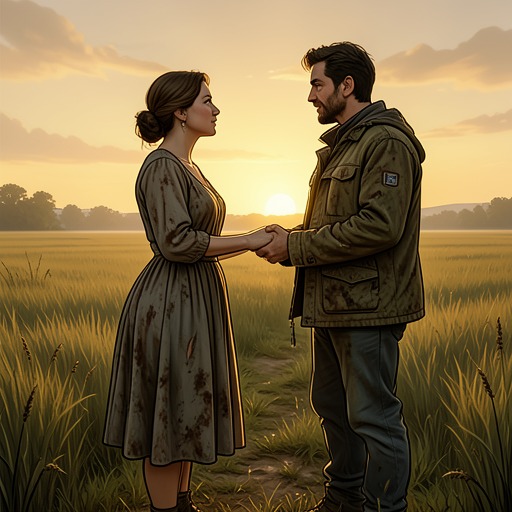
Kya and Tate kiss and begin dating
Where the Crawdads SingKya and Tate kiss and begin dating in an autumn scene where emotional intimacy grows out of their lessons and shared attention to the marsh. Their first kiss is preceded by an unusually frank exchange about loss: Tate tells Kya that his mother and sister died in a car wreck, and Kya tells him that her own mother walked away and never returned. The scene turns companionship into chosen romantic closeness, with a kiss, a direct question about whether Kya is Tate’s girlfriend, and an affirmative answer from both of them.
Setting and the Question Between Them
Autumn comes into the woods through the sycamores: thousands of golden leaves stand out against the slate-gray sky, while the evergreens seem unchanged. After a lesson, Tate lingers instead of leaving. Sitting together on a log, Kya asks a question she has wanted to ask for months: why has he taught her to read and brought her things? She wonders whether he has a girlfriend. The question brings into the open a feeling the lessons have allowed to develop without either of them naming it. Tate explains that he likes the quiet and values Kya’s interest in the marsh. His answer also distinguishes her attention from the way other people regard the wetland: they treat it as wasteland to be drained and developed, although sea creatures, including creatures people eat, depend on it. The exchange establishes that their connection rests not only on Tate’s help with reading, but on a shared respect for a place most of the community misunderstands. That respect has a protective edge. Tate does not tell Kya that he feels sorry for her loneliness or describe how the villagers have mocked her as the Marsh Girl. Boys have made sneaking out to her shack and tagging it a regular initiation, and some have placed bets about who will first have sex with her. Their behavior angers and worries Tate. The contrast gives his lingering at the lesson a larger context: he is offering attention and instruction in a community where others have made Kya’s isolation an excuse for cruelty.
Loss and Confession
The conversation turns from why Tate comes to Kya to what each of them has lost. Tate tells her that his mother and little sister, Carianne, died in a car wreck in Asheville. He has never spoken about their deaths to anyone before. Kya responds with sympathy and says she imagines his mother was kind and pretty. She then tells him that her own mother walked away one day and did not come back, measuring the abandonment against the pattern of the mother deer, who return. Their losses are not identical. Tate’s family members are dead and will not return; Kya still frames her mother’s departure as an absence that might, at least in nature’s pattern, be reversed. Tate makes that difference explicit: Kya can hope, whereas he knows his mother will not come back. The scene lets them speak from separate kinds of grief without making one equivalent to the other. Kya’s understanding also gives Tate room to continue. She waits patiently when he begins and then stops, and invites him to say what he has held back. Tate believes that his mother and Carianne went to Asheville to buy him a particular bicycle for his birthday because the local Western Auto did not carry it. He knows their trip was not his fault, but says that it feels like his fault; he cannot even remember what kind of bicycle he wanted. Kya answers that the accident was not his fault. The confession reveals the private guilt beneath his earlier silence, while his admission that he has never discussed the deaths makes the exchange a rare act of trust between them.
From Proximity to the First Kiss
As Kya leans closer, she does not quite touch Tate. She senses that the space between their shoulders has shifted and wants their arms to brush, wondering whether he will notice. The narration stays with the tentative, physical beginnings of intimacy: a wish to cross a small distance, not a declaration of love. The wind rises at that moment, and sycamore leaves break loose and stream across the sky, placing the two characters in motion as their closeness changes. Tate turns the falling leaves into a game, calling for them to catch as many as they can before they reach the ground. Kya jumps up with him. They leap and skip through the curtains of leaves, reaching and snatching; Tate dives for one near the ground, catches it, and rolls over with it raised like a prize. Kya releases the leaves she has gathered back into the wind, then runs among them with gold caught in her hair. Their shared play replaces the hesitation of the conversation with movement and laughter, but it does not erase the vulnerability they have just disclosed. When Kya turns, she bumps into Tate. They stop and look at each other; he takes her shoulders, hesitates, and kisses her. The falling leaves continue around them, but the decisive change is between the two of them: play has become a first kiss. Kya has no experience of kissing and initially holds her head and lips stiff. After they part, both appear unsure how to understand what has happened. Tate gently lifts a leaf from her hair and drops it. Kya’s heart beats wildly, and the kiss feels unlike the ragged forms of love she has known within her wayward family.
Naming the Relationship
Kya asks whether she is Tate’s girlfriend now. The question matters because the kiss alone has not settled what their new closeness means; she asks him to name it with her. Tate answers by asking whether she wants to be. Kya says yes. He raises the possibility that she may be too young, and Kya replies that she knows feathers, distinguishing herself from the other girls through the particular knowledge that marks her life in the marsh. The exchange keeps the beginning of the romance grounded in who she is rather than turning her into a conventional courtship figure. Tate accepts her answer, and they kiss again. This time Kya tilts her head and softens her lips. The physical change is small but clear: after the uncertainty of the first kiss, she meets him more readily. Her response culminates in the feeling that, for the first time in her life, her heart is full. The relationship begins not through an elaborate promise, but through mutual consent spoken plainly and confirmed in action.
Significance of the Scene
The event changes the lessons’ meaning without displacing them. Tate’s teaching and Kya’s interest in the marsh have already created a connection; the conversation about family loss deepens it, and the kiss gives it a new, explicitly romantic form. The scene joins two kinds of recognition: Tate sees the loneliness and social vulnerability others exploit, while Kya receives his grief without dismissing the guilt attached to it. Their exchange is intimate because both disclose what they have not easily said elsewhere. The autumn leaves bind the scene’s emotional movement to its setting. They first mark the season, then become the material of shared play, and finally surround the kiss. Their flight does not explain or guarantee what will follow; within this event, it accompanies a transition from uncertain proximity to an acknowledged relationship. Kya’s question and Tate’s answer make the change unmistakable: after the kiss, they are no longer only teacher and student or companions in the woods, but a couple beginning to choose one another.